

A drone doesn't have to be large, fast or heavily armed to create a serious security challenge. As commercial and military unmanned aircraft systems (UAS) become increasingly sophisticated, autonomous and accessible, organizations face unprecedented vulnerabilities from the air.
This creates new challenges for people responsible for protecting airports, military installations, critical infrastructure and large public events. The Federal Aviation Administration recorded over 400 drone-related sightings near aircraft and airports between July and September 2024.
As a result, counter-unmanned aircraft systems (C-UAS)—the technologies and procedures used to detect, track, identify and stop unauthorized or hostile drones—are evolving alongside the drone technologies they are designed to counter. According to MarkNtel Advisors, the global counter-unmanned aerial system market was valued at $5.12 billion in 2025 and is projected to scale from $8.5 billion in 2026 to $27.98 billion by 2032.
In this article, MAG Aerospace examines five changes reshaping the counter-drone landscape—and why they are making unauthorized drones harder to detect and defeat.
1. Drones Are Becoming More Autonomous
The growing use of unmanned aircraft systems is changing both conventional warfare and domestic security. Drones inherently offer immense utility across agriculture, logistics, telecommunications, and media. However, the exact characteristics that make drones commercially viable—low acquisition costs, high maneuverability, autonomous navigation, and flexible payload options—have also been exploited by state adversaries, violent non-state actors (VNSAs), and transnational criminal organizations. The threat has evolved rapidly from isolated incidents involving negligent hobbyists to highly coordinated operations designed to bypass traditional air defense networks.
Critical Infrastructure and Aviation Vulnerabilities
The vulnerability of critical infrastructure to drone incursions is a well-documented and growing concern. Commercial airports, energy grids, and military installations are high-value targets where even minor disruptions can have massive economic and psychological consequences. The defining moment for civil aviation occurred in December 2018 at Gatwick Airport. Repeated unauthorized drone sightings near the runway forced the airport to shut down for more than a day during the busy holiday travel season. The disruption caused approximately 1,000 flights to be canceled or diverted, affected around 140,000 passengers, and cost airlines tens of millions of dollars. This incident exposed gaps in airspace monitoring and accelerated the global adoption of multi-sensor C-UAS systems—combining radar detection, electro-optical cameras, and tracking tools—at major transportation hubs.
Energy infrastructure faces similar, if not more severe, risks. In July 2020, federal investigators discovered a modified commercial drone near a Pennsylvania electrical substation. The system had been intentionally stripped of identifying components and rigged with nylon cords and copper wire in a calculated attempt to create a short circuit across the high-voltage substation equipment. While the drone crashed prematurely before reaching its target, a joint bulletin from federal agencies (including the FBI and DHS) warned that the incident was a clear proof of concept. Inexpensive commercial off-the-shelf (COTS) technology can easily be weaponized for domestic sabotage, prompting utility operators to rapidly invest in radio-frequency (RF) monitoring, thermal imaging, and perimeter radar networks.
2. Some drones can no longer be stopped by traditional jamming
One of the most significant developments in the drone threat is the emergence of humanoid robotics, and fiber-optic controlled systems.
A highly detailed 2026 Global Drone Threat Report highlights a rapid shift from warzones to criminal enterprises, including the growing use of artificial intelligence-enabled targeting modules and fiber-optic control (FOC) lines. Fiber-optic controlled drones unroll a tiny, lightweight fiber line as they fly. Because they send information through this physical cable instead of wireless radio signals, they cannot be jammed or tricked by traditional RF jamming and global navigation satellite system (GNSS) spoofing, and they are completely invisible to radio scanners.
At the same time, edge-AI allows drones to autonomously recognize targets, process sensor data, and navigate complex terrain with less reliance on a human operator. In some cases, these systems can continue operating even if communication with the operator is lost.
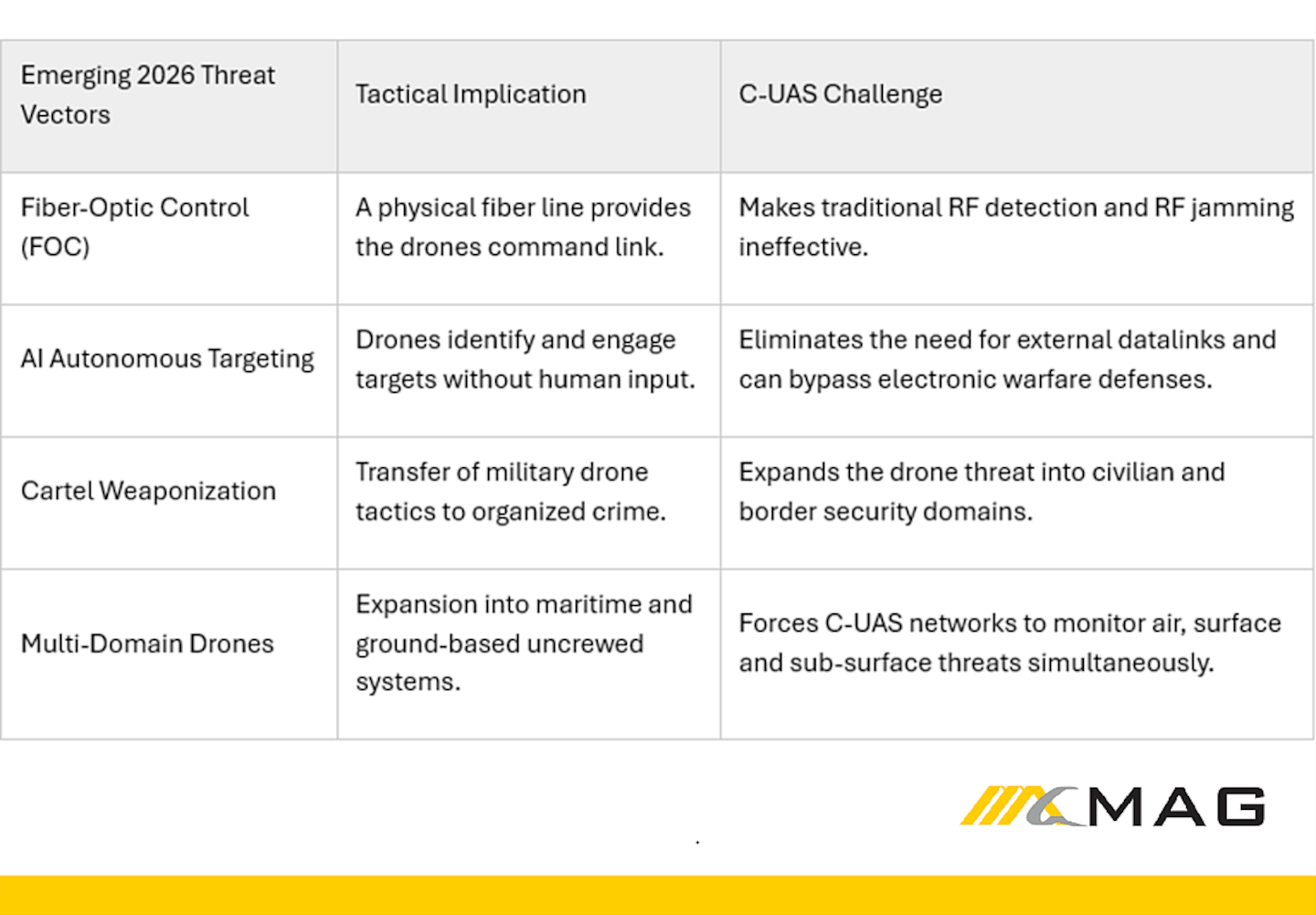
MAG Aerospace
These advancements are pushing counter-drone defenses away from reactive, single-sensor point systems to more predictive, multi-layered networks that can detect and respond to multiple threats at once. Future counter-drone architectures must detect threats earlier, respond faster, and cover larger areas without relying solely on expensive traditional missile interceptors.
3. Defenders Are Facing More Drones at Once
Advancements in drone technology are also changing how drones can be used in groups or “swarms.” Observations from modern conflicts, particularly the war in Ukraine and operations in the Middle East, demonstrate how combatants are using swarms of inexpensive, expendable drones to overwhelm and exhaust expensive, traditional air defense interceptors.
The growth of autonomous drone swarms is also driving investment in counter-drone technologies. The autonomous drone swarm security market is projected to reach $6.51 billion by 2030. Additionally, the market for combat aircraft swarm radars—systems specifically designed to detect and track massive, coordinated drone swarms—was calculated at $2.36 billion in 2025 and is expected to reach $4.96 billion by 2035, growing at a 7.7% compound annual growth rate.
4. No Single Sensor Can See Every Drone
Effective C-UAS operations depend on detecting drones early, accurately, and continuously. Because commercial and tactical drones are small, made of materials that absorb radar waves, and maneuver unpredictably as close to the ground as physically possible, traditional aviation radar and air traffic control systems are generally incapable of reliably tracking them. As a result, specialized C-UAS networks rely on a combination of the following sensor technologies, each one designed to exploit a different physical, acoustic, or electromagnetic signature of the intruding drone.
Radio Frequency (RF) Analyzers
Most commercial and modified drones rely on RF signals to communicate with their remote operators, transmit live camera feed, flight data, and receive satellite navigation data (GNSS/GPS). RF analyzers use specialized antennas and receivers to scan the electromagnetic spectrum for the distinct transmission protocols and hopping patterns—the process of hopping between different radio frequencies dozens of times per second—used by unmanned systems.
When an RF sensor detects a drone’s control link or live flight data, it can frequently collect important information about the drone. Advanced RF systems can identify the exact make, model, and sometimes the unique serial or MAC address of the drone. More importantly, through techniques such as time difference of arrival (TDOA) or angle of arrival (AoA), which use multiple connected antennas, RF sensors can pinpoint the exact geographic location of the drone operator on the ground. This gives security forces a major advantage by allowing them to dispatch law enforcement to apprehend the pilot and neutralize the threat at its source.
However, RF detection has inherent limitations. It is limited by line-of-sight constraints, can be affected by heavy radio-frequency activity in urban areas, and cannot detect autonomous drones operating under emission control (EMCON) or those utilizing the newly emerging fiber-optic tethers, which produce no RF signatures.
Specialized Radar Systems
Radar (radio detection and ranging) remains the foundational backbone for spotting faraway aircraft. Normal airport radars are built to see massive airplanes. Specialized C-UAS radar systems differ significantly as they operate at higher frequencies (such as X-band or Ku-band) and utilize sophisticated Doppler processing to detect the speed and vibration of the spinning propellers’ micro-Doppler signatures. While a drone’s plastic body is too small to easily bounce radar waves back, the high-speed spinning rotors create unique micro-Doppler shifts that can be separated from the movement of biological clutter, such as flocks of birds or swaying trees.
The defense market is seeing a rapid transition toward active electronically scanned array (AESA) radars for C-UAS applications. AESA systems utilize thousands of individual solid-state transmit/receive modules to electronically steer radar beams without needing to physically move. This allows the radar to scan the entire sky and lock on to multiple targets at the same time, an essential capability for detecting and countering dense, coordinated drone swarms. These specialized radar systems are highly effective regardless of whether the drone is actively emitting an RF signal, and function exceptionally well in adverse weather conditions like heavy rain or thick fog, providing persistent 360-degree coverage.
Electro-Optical and Infrared (EO/IR) Cameras
Visual verification is a critical step in the “kill chain” or shutdown process. Security operators need to visually confirm what a radar or RF track has detected before taking action to ensure they are not targeting a civilian aircraft or a bird. Electro-optical cameras provide high-definition, magnified visual tracking during daylight hours, while infrared (thermal) cameras detect the heat produced by drone motors, batteries, and payloads, enabling 24/7 operations in complete darkness or through light obscurants like smoke and fog.
EO/IR systems are rarely used to search large areas on their own because they have a narrow field of view. Instead, they are integrated with radar or RF sensors via an automated “slew-to-cue” mechanism—a term that means the camera and radar communicate with each other. When the primary radar sensor detects an anomaly, it instantly sends the location to the EO/IR camera’s base, which allows the camera to swing and point quickly to the target’s precise location. Advanced AI algorithms then take over, locking onto the drone’s pixels to follow it as it moves and to see what the drone is carrying (e.g., determining if the drone is carrying a suspended explosive or a high-resolution camera).
Acoustic Sensors
Acoustic sensors are highly sensitive microphones placed in different locations but networked together to detect the unique sound signatures generated by drone propellers and electric motors cutting through the air. The acoustic data is then compared to a large continually updated digital library of recorded drone sounds. While acoustic sensors can’t detect a drone miles away, unlike radar or RF systems, they are highly valuable in dense urban environments with tall buildings, stadium venues, or heavily forested areas. These obstacles provide surfaces for sound waves to bounce off, but block radar and RF lines of sight.
5. Counter-Drone Systems Have to Process Information Faster
Relying on any single detection method inevitably leaves blind spots in an organization’s security perimeter. An RF-only system will fail to detect a drone flying on autopilot with a pre-programmed path and its radio and video transmitter intentionally turned off. A radar-only system may struggle to tell the difference between a hovering multi-rotor drone and a building in a crowded city. An EO/IR camera is useless for drone detection if it does not know exactly where to look in the vast sky.
Layered sensor fusion, which is the process of combining data from different sensors like RF, radar, EO/IR, and acoustic sensors, into a single command and control (C2) system, solves these issues. In a modern C-UAS platform, artificial intelligence ingests these inputs at the same time and acts as a dispatcher. For example, if the radar system detects a small object flying at drone speeds, the C2 system will check the acoustic network to listen for a matching motor signature. Once the system confirms the threat, it autonomously swings the EO/IR camera to point directly at the target for visual confirmation.
This cross-verification reduces false positive alarms, improves tracking accuracy, and helps security personnel make faster decisions. Instead of monitoring five different screens and trying to connect the information themselves, operators see the data in one place, providing a clear, real-time common operating picture (COP) of the airspace.
How Are Hostile Drones Neutralized? Active Mitigation and Electronic Warfare
The shift toward more sophisticated drone threats is changing the technologies used to defend against them and, therefore, is changing what organizations are buying. According to a market study published by MarkNtel Advisors, mitigation and neutralization systems accounted for nearly 42% of the C-UAS market share in 2026, indicating that organizations are prioritizing technologies that do more than just detection.
Once a drone is detected and identified by a C-UAS platform, the system must offer mechanisms to stop the threat. The following are mitigation technologies used to stop drones, broadly categorized into non-kinetic (electronic/cyber) and kinetic (physical) solutions.
Electronic Warfare: Jamming and Disruption
Jamming is the most common and historically prevalent form of C-UAS mitigation. It works by sending a high-power burst of electromagnetic energy on the specific frequencies a drone uses for control and navigation (typically the 2.4 GHz and 5.8 GHz ISM bands, alongside GNSS/GPS bands). By creating enough interference, the jammer effectively severs the communication link between the drone and its pilot.
When a commercial drone loses its connection to the pilot, it triggers a pre-programmed safety response, which typically includes the drone halting its current trajectory and hovering in place, initiating a controlled vertical descent, or attempting a “return to home” (RTH) maneuver back to its original launch coordinates. While highly effective against commercial off-the-shelf drones, jamming is a brute-force approach. The strong RF energy it produces can also interfere with legitimate civilian communications, air traffic control, and emergency medical services networks in the vicinity.
Cyber Takeover and Signal Spoofing
Spoofing and protocol manipulation offer a more targeted approach to stopping a drone. Rather than simply blasting noise to block a signal indiscriminately, spoofing sends fake GPS coordinates or replicated control commands directly to the drone’s navigation systems. This electronic deception tricks the drone into believing it is in a different location or causes the drone to accept commands from a security operator instead of the original pilot.
Advanced cyber-over-RF (CoRF) protocol manipulation technologies can safely commandeer the drone by identifying, tracking, and taking control of unauthorized UAS with high precision. This allows operators to override the drone’s systems, steer it away from important buildings, and land it securely in a chosen parking lot or field. This method is most useful in dense urban areas and airports, as it stops the threat without jamming surrounding communications networks or causing the drone to fall unpredictably onto civilians.
Kinetic Interceptors and Directed Energy
As threat actors increasingly use fiber-optic controls, autonomous AI navigation, and advanced anti-jamming antennas, jamming and spoofing methods are becoming less reliable. When a drone operates without an RF link or ignores electronic disruption, kinetic mitigation is the only other option to physically stop the drone mid-flight.
Kinetic solutions range from net guns that fire heavy mesh to entangle rotors to sophisticated, high-speed interceptor drones. The economics of drone warfare are also shifting. Rather than firing multi-million-dollar missiles at cheap drones, defense contractors are developing low-cost, single-use autonomous interceptors that can match the speed and maneuverability of incoming threats, effectively creating a drone-on-drone method for stopping hostile drones.
For military and high-tier government facilities, directed energy weapons (DEWs) are moving to the forefront. High-energy lasers and high-power microwaves (HPM) are being added into some base defenses to instantly fry a drone’s internal circuitry or physically destroy its airframe at the speed of light, providing a way to stop large swarms without the limits of traditional ammunition.
What Are the Legal Rules for Using C-UAS Technologies?
While C-UAS technology advances at breakneck speed, the legal environment governing its use remains highly restrictive, complex, and strictly enforced. In the United States, the deployment of active mitigation technologies is tightly regulated by multiple federal agencies to ensure aviation safety and communications integrity.
Under federal law Title 18 U.S.C. § 32, the Federal Aviation Administration (FAA) classifies drones of all sizes as "aircraft." Consequently, shooting down, destroying, disabling, or physically intercepting a drone is a severe federal crime, legally treated similarly to destroying a manned passenger plane. Furthermore, the Federal Communications Commission (FCC) strictly prohibits the use of signal jamming equipment by unauthorized entities. Unauthorized RF emissions violate the Communications Act of 1934 and can critically disrupt legitimate aviation, cellular, and emergency responder frequencies.
This means that only highly specific federal agencies—such as the Department of Defense (DoD), the Department of Homeland Security (DHS), the Department of Energy (DOE), and the Department of Justice (DOJ)—possess the statutory authority to actively jam, spoof, or kinetically intercept drones within the United States.
Despite massive federal expansions and funding influxes, private organizations, critical infrastructure operators, and local law enforcement are generally prohibited from actively neutralizing drones themselves. For non-federal entities, a legally compliant C-UAS strategy focuses exclusively on passive detection, tracking, real-time threat verification, and the rapid sharing of actionable intelligence with authorized federal responders.
Securing the Skies of Tomorrow
Looking toward 2026 and beyond, the technological arms race between drone manufacturers and C-UAS developers is accelerating at an unprecedented pace. The prevailing trend is the weaponization of artificial intelligence. Future drone threats will rely less on remote human pilots transmitting target data over vulnerable RF links and more on autonomous systems and swarms capable of self-healing networks, collaborative targeting, and fiber-optic communication.
To counter this, C-UAS defense architectures are transitioning away from localized point-defense systems toward massive, integrated regional networks. Future defenses will leverage cloud-based AI to analyze large datasets of drone flight paths, predicting unauthorized entry before drones breach perimeters.
By understanding the technologies and the legal framework surrounding them, organizations can build effective defenses against unauthorized unmanned aircraft.
This story was produced by MAG Aerospace and reviewed and distributed by Stacker.


